Why Pastoral Certification Is Becoming More Important in Uganda
In Uganda, many pastors are already carrying the weight of ministry long before they ever have access to formal theological education. They are preaching, counseling families, discipling new believers, and leading churches – often with limited resources and little opportunity for structured training. Advancing and Uplifting Humanity helps bridge that gap by supporting pastors as they pursue theological training and complete certification processes that strengthen their ministry, deepen their biblical understanding, and provide recognized documentation of their preparation. By removing barriers to education and certification, AUH helps local pastors serve with greater confidence, accountability, and effectiveness while continuing to lead the communities that already depend on them.
Across Uganda, pastors often serve far beyond the walls of a church.
They preach and teach Scripture, counsel families, guide young people, support people through illness and grief, lead community outreach, and in many rural areas become trusted figures within communities that may have limited access to other forms of institutional support.
Yet not every pastor begins ministry with access to formal theological education.
For some, the calling comes first. The classroom comes later.
That is why pastoral training and certification have become an increasingly important part of Uganda’s Christian landscape and why organizations such as Advancing and Uplifting Humanity (AUH) are helping pastors gain the knowledge and training they need to serve their communities with greater confidence and preparation.

A History of Theological Training in Uganda
Formal theological education in Uganda has roots stretching back more than a century.
Uganda Christian University traces the country’s first theological college to Bishop Tucker Theological College, established in Mukono in 1913, following an earlier church leadership school that had begun at Namirembe. The college trained clergy and educators for 84 years before becoming part of Uganda Christian University in 1997.
For much of the early period, theological training was closely associated with established denominations and residential institutions.
As Uganda’s Christian landscape expanded, however, new approaches emerged.
Uganda Baptist Seminary, founded in 1988, adopted a decentralized model designed around people who were already serving in ministry. Rather than requiring pastors to leave their churches for years of uninterrupted residential study, students could attend intensive training periods and return to their congregations between terms.
That model remains important today.
Uganda Baptist Seminary, for example, currently operates certificate, diploma, bachelor’s and master’s-level theological programs. Its Certificate in Theology is designed specifically for people already serving in church ministry and is intended to strengthen both theological understanding and practical application in their communities.
The result is a system in which pastoral education can take several forms from denominational training and shorter ministry courses to formal tertiary theological credentials.
Why Certification Matters
A certificate does not make someone a pastor.
But structured training can help a pastor become better prepared for the responsibilities that come with ministry.
Pastors are regularly expected to interpret Scripture, preach accurately, counsel families, mentor young believers, respond to difficult theological questions, manage church responsibilities, and lead others.
Those responsibilities require more than enthusiasm.
They require knowledge.
Formal theological programs can expose pastors to biblical interpretation, theology, preaching, pastoral care, ethics, counseling, and practical ministry.
Uganda Baptist Seminary states that its certificate program is intended to help church leaders practice and teach biblical exposition, address issues within their churches and communities, and apply counseling and ministry skills in practical settings.
For pastors who have already been serving for years without access to formal schooling, certification can also provide something important: a structured pathway for strengthening what they have learned through experience.

Who Needs This Training?
Pastoral training is especially relevant for leaders who are already serving churches but cannot simply leave their communities and enroll in full-time residential education.
Uganda Baptist Seminary’s modular system is one example: students attend intensive terms while remaining connected to their ministries between sessions. In its current model, students come to Jinja for one-month terms three times per year.
Certificate-level programs can also provide an entry point for people who may not yet qualify for higher theological degrees.
At Uganda Baptist Seminary, the Certificate in Theology accepts applicants with specified secondary-school qualifications, including certain pathways for applicants with Primary Seven education plus additional certificate training.
This matters in rural ministry.
A pastor may have years of experience leading a congregation but limited access to formal higher education.
Training programs allow that pastor to strengthen biblical interpretation and ministry skills without assuming that calling, experience and education must always arrive in the same order.
Uganda’s Proposed Religious Organizations Policy
The question of pastoral training has also entered Uganda’s national policy debate.
Uganda does not currently operate a single centralized government licensing board that certifies every pastor before he or she can preach.
Religious organisations operate through different denominations, church networks and institutions, while theological qualifications are awarded by individual training institutions and, where applicable, accredited higher-education providers.
However, the Ugandan government has been developing a Religious and Faith Organizations policy, often referred to as the RFO or RFBO policy.
The process has been led by the Directorate for Ethics and Integrity in the Office of the President. The Directorate’s Religious Affairs Department currently coordinates government engagement with religious and faith organizations, maintains information on their operations and makes recommendations concerning organizations seeking registration.
Government officials have said the proposed policy is intended to address issues including accountability, unethical conduct, manipulation of congregations and gaps in formal training among some religious leaders.
Training has therefore become one of the most closely watched parts of the debate.
During consultations, some religious leaders supported introducing clearer qualification expectations for people seeking to lead religious organizations. Others particularly some Pentecostal and born-again leaders raised concerns that government regulation could interfere with religious freedom or impose inappropriate oversight on churches.
Regional consultations and validation exercises continued through 2024 and 2025. As of the latest reporting available, the government was still working toward a national policy framework; it should therefore not be described as an already-enforced nationwide requirement that every Ugandan pastor must hold a theological certificate.
That distinction matters.
Pastoral training is already valuable in its own right.
The policy debate simply makes preparation, theological education and institutional accountability even more relevant.

How Advancing And Uplifting Humanity Is Helping Pastors Move Forward
This is where the work of Advancing and Uplifting Humanity becomes especially practical.
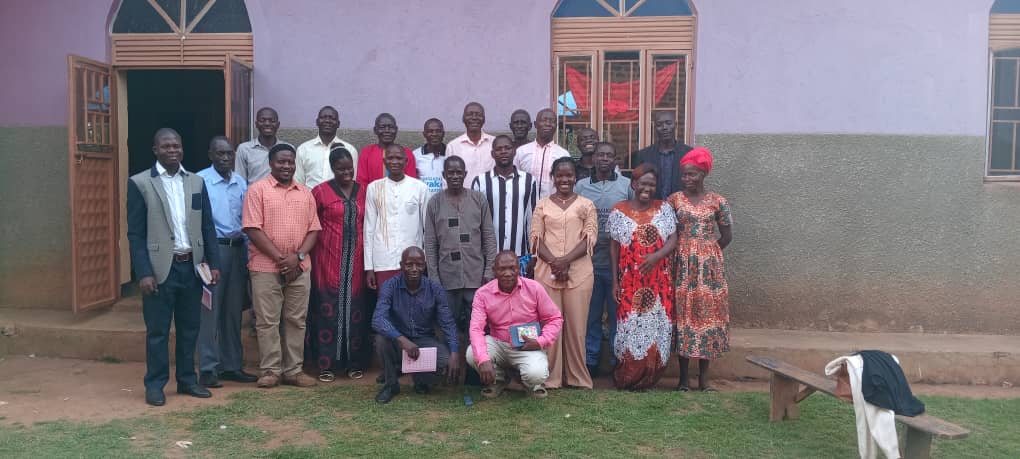
The pastors shown in these photographs are not being trained in an abstract environment disconnected from ministry.
They are people already serving communities.
AUH helps bring pastors and ministry leaders together for training, instruction, discussion and spiritual development creating opportunities for them to strengthen their knowledge while continuing the work they are already doing.
The photographs show leaders gathered around tables, pastors listening during teaching sessions, smaller groups working together indoors, and a much larger gathering assembled outdoors.
They illustrate something important about pastoral education in Uganda:
training can go where the pastors are.
For a rural or bi-vocational pastor, distance, tuition, transportation and time away from a congregation can all become barriers to further education.
Helping pastors access training closer to home can reduce some of those barriers.
And when certification is available through an appropriate theological or ministry program, it can give pastors a structured record of the training they have completed.
AUH’s role is therefore not to create a government license to preach.
It is to help pastors become better equipped to do what they have already been called to do.
To understand Scripture more deeply.
To teach more carefully.
To disciple new believers.
To counsel families responsibly.
To strengthen local churches.
And to prepare themselves for a religious environment in Uganda that is placing increasing attention on education, ethics and accountability.
Why Training One Pastor Can Reach Far Beyond One Person
The impact of pastoral training does not stop with the person receiving the certificate.
A trained pastor returns to a congregation.
That pastor teaches families.
Mentors younger leaders.
Preaches week after week.
Counsels people through difficult moments.
Helps guide new believers.
Trains others.
And may eventually help plant or strengthen additional churches.
This creates a multiplier effect.
One pastor receiving stronger theological and practical preparation can influence hundreds of people over years of ministry.
That is why supporting pastors is different from funding a one-time event.
It is an investment in the people who remain after visiting missionaries leave.
Local pastors are there on ordinary Sundays.
They are there when a family needs prayer.
They are there when a young believer has questions.
They are there when a community faces hardship.
And they are there to carry the Gospel forward in their own language, culture and community.
Removing Barriers Without Changing the Calling
Certification should not be confused with calling.
A certificate cannot create faith, compassion or commitment.
But education can strengthen the person who already possesses those things.
For pastors who have spent years serving without access to formal training, the opportunity to study can provide knowledge, confidence and a stronger foundation for ministry.
It can also prepare them for a future in which churches and religious leaders in Uganda may face clearer expectations around governance, accountability and training if the proposed RFO policy ultimately moves forward.
For AUH, the goal is straightforward:
help remove the barriers that keep committed pastors from becoming better equipped to serve.
Not to replace local leadership.
To strengthen it.
Not to take ministry away from Ugandan pastors.
To place more tools into their hands.
Because the long-term future of the Church in Uganda will ultimately depend on the people who live there, preach there, disciple there and continue serving their communities every day.
And when those pastors are trained, supported and equipped, the impact can reach far beyond any classroom.
It can reach an entire generation.